
Martes 30 Jun 2015


POPART LONAS IMPRESAS:
LAS LONAS PUBLICITARIAS IMPRESAS CON LA MAXIMA RESOLUCION Y CON TODO LUJO DE DETALLES PUEDEN SER MONTADAS SOBRE ESTRUCTURAS SIN CORDAJES EN FACHADAS, O PAREDES DE STANDS. SUS SUSTITUCION SE REALIZA FACILMENTE

POPART CARTELES FOTOGRAFICOS:
EL VINILO ADHESIVO IMPRESO EN CALIDAD FOTOGRAFICA, MONTADO SOBRE CARTON PLUMA PERMITE REALIZAR TODO TIPO DE MONTAJES DE CARTELERIA INTERIOR. LA IMPRESION EN ALTA RESOLUCION PROPORCIONA MAXIMA CALIDAD

POPART VINILO PUBLICITARIO:
EL VINILO ADHESIVO REMOVIBLE IMPRESO CON CALIDAD HQ CONVIERTE UNA SUPERFICIE EXTERIOR EN UN PERFECTO SOPORTE PARA UN RECLAMO PUBLICITARIO. SU RETIRADA NO PLANTEA PROBLEMAS NI DEJA RESTOS DE ADHESIVO.

POPART EXPOSITORES DISPLAYS:
EL RECLAMO PUBLICITARIO MONTADO SOBRE EXPOSITORES DISPLAYS, ROLL UP, POP UP Y ENARAS APORTAN A LA EXPOSICI�N PUBLICITARIA EL DON DE LA MOVILIDAD SIENDO FACILMENTE DESPLEGABLE Y RECOGIBLE LA GRAFICA UTILIZADA.

POPART ROTULACION:
VINILOS DE MULTIPLES COLORES PERMITEN ROTULAR TODAS LAS SUPERFICIES POSIBLES CON LOGOTIPOS Y TEXTOS. ROTULACION LUMINOSOS, VEHICULOS, SE�ALETICA, TODO ES POSIBLE...
| ¿Qué es una tinta DYE? |

|

|
|
{Button}
Se conocen como tintas DYE aquellas sustancias coloreadas que pueden tener afinidad con diferentes sustratos sobre los que se desean aplicar.
Esto quiere decir, que los materiales sobre los que se impriman deben estar emulsionados convenientemente para que las tintas agarren sobre ellos sin que tiendan a descolgarse del material.
Se presentan, generalmente, disueltas en agua y presentan los colores porque absorben todos los colores del espectro luminoso salvo el que reflejan. Las tintas DYE no soportan la radiación solar ni la acción disolvente del agua, por lo que no pueden ser expuestas a la intemperie y deben laminarse para su protección El uso de pigmentos DYE se remonta a 5000 años ya que en hallazgos arqueológicos han sido descubiertos útiles y restos de pigmentos DYE obtenidos de animales, vegetales o minerales. Fundamentalmente, los pigmentos DYE se han venido obteniendo históricamente del reino vegetal, pero en la actualidad la comercialización a gran escala hace que éstos se obtengan por muchos métodos. Wikipedia extract: The first human-made (synthetic) organic dye, mauveine , was discovered by William Henry Perkin in 1856. Many thousands of synthetic dyes have since been prepared. Synthetic dyes quickly replaced the traditional natural dyes. They cost less, they offered a vast range of new colors, and they imparted better properties upon the dyed materials. [1] Dyes are now classified according to how they are used in the dyeing process. Acid dyes are water - soluble anionic dyes that are applied to fibers such as silk , wool , nylon and modified acrylic fibers using neutral to acid dyebaths. Attachment to the fiber is attributed, at least partly, to salt formation between anionic groups in the dyes and cationic groups in the fiber. Acid dyes are not substantive to cellulosic fibers. Most synthetic food colors fall in this category. Basic dyes are water-soluble cationic dyes that are mainly applied to acrylic fibers , but find some use for wool and silk. Usually acetic acid is added to the dyebath to help the uptake of the dye onto the fiber. Basic dyes are also used in the coloration of paper . Direct or substantive dyeing is normally carried out in a neutral or slightly alkaline dyebath, at or near boiling point , with the addition of either sodium chloride (NaCl) or sodium sulfate (Na 2 SO 4 ). Direct dyes are used on cotton , paper, leather , wool, silk and nylon . They are also used as pH indicators and as biological stains . Mordant dyes require a mordant , which improves the fastness of the dye against water, light and perspiration . The choice of mordant is very important as different mordants can change the final color significantly. Most natural dyes are mordant dyes and there is therefore a large literature base describing dyeing techniques. The most important mordant dyes are the synthetic mordant dyes, or chrome dyes, used for wool; these comprise some 30% of dyes used for wool, and are especially useful for black and navy shades. The mordant, potassium dichromate , is applied as an after-treatment. It is important to note that many mordants, particularly those in the heavy metal category, can be hazardous to health and extreme care must be taken in using them. Vat dyes are essentially insoluble in water and incapable of dyeing fibres directly. However, reduction in alkaline liquor produces the water soluble alkali metal salt of the dye, which, in this leuco form, has an affinity for the textile fibre. Subsequent oxidation reforms the original insoluble dye. The color of denim is due to indigo, the original vat dye. Reactive dyes utilize a chromophore attached to a substituent that is capable of directly reacting with the fibre substrate. The covalent bonds that attach reactive dye to natural fibers make them among the most permanent of dyes. "Cold" reactive dyes, such as Procion MX , Cibacron F , and Drimarene K , are very easy to use because the dye can be applied at room temperature. Reactive dyes are by far the best choice for dyeing cotton and other cellulose fibers at home or in the art studio. Disperse dyes were originally developed for the dyeing of cellulose acetate , and are substantially water insoluble. The dyes are finely ground in the presence of a dispersing agent and then sold as a paste, or spray-dried and sold as a powder. Their main use is to dye polyester but they can also be used to dye nylon, cellulose triacetate , and acrylic fibres. In some cases, a dyeing temperature of 130 °C is required, and a pressurised dyebath is used. The very fine particle size gives a large surface area that aids dissolution to allow uptake by the fibre. The dyeing rate can be significantly influenced by the choice of dispersing agent used during the grinding. Azo dyeing is a technique in which an insoluble azoic dye is produced directly onto or within the fibre. This is achieved by treating a fibre with both diazoic and coupling components . With suitable adjustment of dyebath conditions the two components react to produce the required insoluble azo dye. This technique of dyeing is unique, in that the final color is controlled by the choice of the diazoic and coupling components. Sulfur dyes are two part "developed" dyes used to dye cotton with dark colors. The initial bath imparts a yellow or pale chartreuse color, This is aftertreated with a sulfur compound in place to produce the dark black we are familiar with in socks for instance. Sulfur Black 1 is the largest selling dye by volume. {Button} |
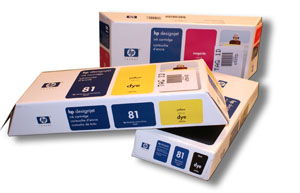 Muy utilizadas en impresión digital, consiguen los más altos grados de calidad en las impresiones de todo tipo de trabajos tanto de
Catálogo de Productos
Encuentra en PopArt
|
|

|
Copyright © 2005 - 2015 popart gráficas.
